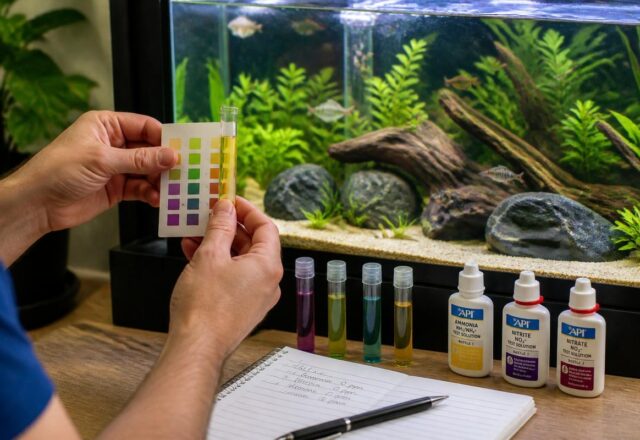
Best Aquarium Test Kits
Aquarium water can look clear and still be unsafe for fish. Ammonia and nitrite are invisible, and both can build…
Read More
Fish live in their water the way we live in air. When the water slips, they feel it in their gills, their skin, and their energy. Yet most water problems build up slowly and quietly, long before the water looks dirty.
That is the good news hidden in the bad news. Slow problems can be caught early with simple habits. Learning how to maintain healthy aquarium water is less about chasing perfect numbers and more about keeping steady ones.
Test ammonia, nitrite, nitrate, pH, and temperature on a regular schedule. Change about 15 to 25 percent of the water each week with conditioned, temperature-matched water. Feed only what fish finish in a couple of minutes, and never replace all your filter media at once.
You do not need a laboratory to keep water safe. A handful of measurements cover nearly every problem a home aquarium can develop. These are the ones worth your attention.
| Parameter | Target for most freshwater tanks | Why it matters |
|---|---|---|
| Ammonia | 0 ppm | Toxic waste from fish and rotting food; harmful at any level you can measure |
| Nitrite | 0 ppm | Forms as bacteria process ammonia; also toxic to fish |
| Nitrate | Below 40 ppm | The end product of the cycle; builds up until water changes remove it |
| pH | Stable; many community fish accept 6.5–7.8 | Sudden swings stress fish more than a steady value slightly off ideal |
| Temperature | Stable and suited to your species | Daily swings weaken fish and invite disease |
Ammonia and nitrite have no safe reading above zero in a stocked tank. Nitrate is different: it is far less toxic, and your weekly water changes keep it in check. Many keepers aim well below the 40 ppm line for sensitive fish.
pH deserves a calm approach. Most common community fish tolerate a wide range as long as it does not swing. A steady pH of 7.6 is safer than a “perfect” 6.8 that jumps around every few days.
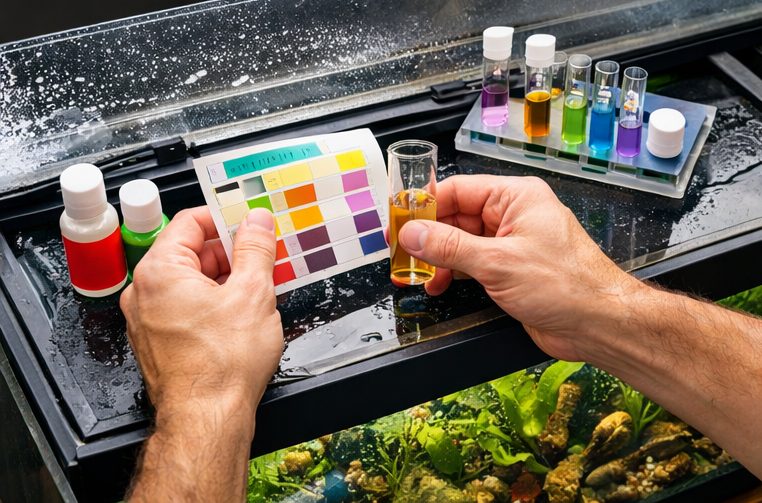
Testing works best as a habit, not an emergency response. In a new tank, test often, because the bacteria colony is still growing and readings can move fast. Daily tests during cycling, then weekly tests once fish are in, give you a clear picture.
In a settled tank, a weekly check of ammonia, nitrite, and nitrate is a sensible rhythm. Test sooner whenever fish act strangely, refuse food, or after you add new fish or change equipment. Write the results down, because a slow trend tells you more than any single reading.
Liquid test kits give clearer, more precise readings than strips, especially for ammonia. Strips are fine for a fast sanity check between liquid tests. Whichever you use, follow the timing on the instructions, since reading a test too early or too late skews the result.
If you keep only one habit, keep this one. A partial water change of about 15 to 25 percent each week removes nitrate, dilutes waste, and replaces minerals that plants and bacteria use up. No filter and no additive does all three jobs at once.
The method matters as much as the amount. Follow these steps each time:
Resist the urge to change half the tank “for a deep clean.” Very large changes swing temperature and chemistry, which stresses fish. Small, steady changes are the whole secret, and they take about fifteen minutes once the routine feels familiar.
Your filter media hosts the bacteria that turn ammonia into nitrate. Treat that colony carelessly and the water quality falls apart within days. Two rules keep it safe.
First, rinse media in a bucket of water you just removed from the tank. Untreated tap water carries chlorine, and chlorine kills the very bacteria you are trying to keep. Second, never replace all the media at the same time, because the colony goes out with the old media.
The same care applies during a filter upgrade. Run the new filter beside the old one for a few weeks, or move the old media into the new unit. The bacteria need a bridge, not a fresh start.
Should I turn the filter off during a water change? You can, if the water level drops below the intake, and many keepers do for safety. Just restart it right after refilling. Media should never sit dry for long, because the bacteria need water and oxygen.
My water is cloudy. Is the filter failing? Not always. Cloudy water in a young tank often means the bacteria are still establishing. Test ammonia and nitrite first, feed lightly, and give it a few days before changing equipment.
Most dirty-water problems start at the surface, with food. Uneaten food rots on the substrate and releases ammonia as it decays. Feed once or twice a day, only what the fish finish in about two minutes, and remove anything left over.
Stocking is the other quiet factor. Every fish adds waste every day, and the filter bacteria can only process so much. A tank stocked for its real size stays stable with normal care, while an overstocked tank needs constant rescue.
Live plants help at the margins, since they absorb some nitrate as they grow. They are a useful ally, but they do not replace water changes or testing. Think of them as support for the routine, not a substitute for it.
A bad reading is information, not a disaster, if you act in the right order. If ammonia or nitrite reads above zero, change about a quarter of the water the same day with conditioned water. Then feed lightly and test again the next day.
Next, look for the cause instead of only treating the number. Check whether the filter is running, whether food is piling up, and whether a fish has died unnoticed. Fixing the cause stops the reading from climbing back.
Nitrate creeping past 40 ppm is less urgent but still a clear message. Bring your water changes back on schedule, vacuum the gravel more thoroughly, and check that you are not overfeeding. Slow corrections protect fish better than sudden, drastic ones.
Change about 15 to 25 percent of the water once a week for most stocked freshwater tanks. That rhythm keeps nitrate below 40 ppm and replaces minerals steadily. Lightly stocked or heavily planted tanks sometimes stretch the interval, but weekly changes are the safest default for new keepers.
Ammonia and nitrite should always read 0 ppm in a stocked tank. Keep nitrate below 40 ppm, and lower for sensitive species. pH should stay stable, with many community fish accepting 6.5 to 7.8, and temperature should match your species without daily swings.
Liquid kits are generally more accurate and easier to read, especially for ammonia, which matters most. Strips are quicker and can work for a rough check between full tests. For cycling a new tank or diagnosing a problem, a liquid kit is the better tool.
High nitrate usually means waste is entering the water faster than changes remove it. Common causes are overfeeding, overstocking, and skipped water changes. Feed less, vacuum the gravel during changes, and return to a weekly schedule. Live plants also absorb some nitrate as they grow.
Only after treating it with a water conditioner. Tap water contains chlorine or chloramine, which harm fish and kill filter bacteria. Condition every bucket of new water before it goes into the tank, and match its temperature to the aquarium to avoid shocking the fish.
Clear water can still hold ammonia or nitrite, which are invisible and dangerous. Appearance is not a reliable test, so measure instead of guessing. A weekly liquid test for ammonia, nitrite, and nitrate tells you what your eyes cannot.
Healthy aquarium water comes from a short list of steady habits: test weekly, change water weekly, feed with restraint, and guard your filter bacteria. None of it is glamorous, and all of it works. Your fish will show the difference in color, appetite, and calm behavior.
To build your testing routine, explore our Water Testing & Treatment Equipment guides for help choosing and using test kits and conditioners.
Aquarium water can look clear and still be unsafe for fish. Ammonia and nitrite are invisible, and both can build…
Read More